Visar inlägg med etikett Gardening - Vegetables. Visa alla inlägg

torsdag 23 juni 2011

Chili 'Piment d'Espelette'

Latin: Capsicum Annuum
Swedish: Chilipeppar 'Piment d'Espelette'
English: Chili 'Piment d'Espelette'

We planted four of these guys a lot of time ago, on the 27/2-2011. Though, only two plants actually made it to "grown stage". Unclear why, but well: it seems these two will pretty much cover our needs for chili for the next 5 years to come (not because of the high production but rather low usage).
They looked pretty small for a very long time. Following instructions is not always the best way to go. Those recommended to put them in a cool place, which we did, but for that reason, they stayed small for months.
Moving them back into our warm house again, made them start to grow. Shortly ago, they have also started to flower.
The flowers do not look like much and are rather difficult to spot, but under scrutiny, I personally think they look rather sweet.
In order to get chili  we understood we were forced to pollinate the flowers, so we have done some "touching work". And that has given results -  two so far to be specific...

And surprise: have been able to spot those two guys. We very happy. Last time we got a chili plant to take care of we killed it within 1 week time... so this is really going over expectations.
31/7 - Head count for chili fruits gave at least 8, some of which rather large and some very small. But there are at least 4-5 new flowers. All chilis are still very grey and do not look anything like "ripe" chilis yet.

Producer's Description
This sort is ideal for outdoor cultivation. Fruits rich in vitamine can be used fresh, dried or deep frozen. It is possible to mix the chilis to chili powder. It is good for one's well-being. Remove the hot seeds before eating. It requires heat, but it can be grown in a pot on the patio, on the balcony or in the greenhouse. Water and fertilize regularly.

Producer's Instructions
Sow sparsely on moist sowing soil. Cover with a thin layer of soil. Keep most at 20-22 degrees and cover with plastic foil. After they have grown, keep them in a light and chilly place... :) Plant them in pots separately when the plans are around 5cm tall. They may be planted outside when night temperature is over 8 degrees.
Planting: January through March
Fruits: July through the beginning of October
Plant at 0,5cm depth with a distance to other plants of 40cm in all directions

torsdag 16 juni 2011

Spring onion 'White Lisbon'

Latin: Allium fistulósum
Swedish: Salladslök ' White Lisbon'
English: Spring onion 'White Lisbon'
Producer: Bröderna Nelson, purchased some while ago this spring I think

Planted 8/6-2011 (See scheme for raised bed)
The raised bed contained for the most soil from the EcoCenter (low quality soil), but it was topped with high qualitative soil for vegetable cultivations from Hasselfors (2,5 bags).
15/6-2011 Still nothing
20/6-2011 Saw the first "greens" sticking out of the ground. Weeew....
Ok, I do understand it does not look like much to the rest of the world, especially those used to ICA Maxi's spring onions, but well...  I am rather happy... :O)

Producer's description
Delicate salad vegetable that can be sown and grown the whole summer. The taste is mild and good as a tender vegetable.
Producer's instructions
Can be planted april to June in soil rich in organic material, ideally rich in lime. It is suggested to plant a row every other week in order to always have tender plants. In order to keep the taste mild, water. To avoid onion flies, cover with non woven.
Depth: 1cm
Distance between plants: 2cm
Distance between rows: 25cm
Full sun
Harvest: About 2 months after sowing

onsdag 15 juni 2011

Beets 'Rhubarb Chard'

Latin: Beta vulgaris
Swedish: Mangold 'Rhubarb chard'
English: Beets 'Rhubarb chard'
Producer: Bröderna Nelson, purchased at ICA Maxi 7/6-2011


Salad is supposed to be watered from below from what I understood from some vegetable growing books. Right now all watering is done automatically with sprinklers, which could be a problem.
This kind of salad seems to be the exact kind you can buy for a lot of money in the  Supermarkets. There, they normally are small dark green leaves with red stems. Look great and taste even better there. Let us see what it results with now. I actually tried to cultivate them before, but I never had the heart to actually eat them as baby leaves. They did not grow very well either. The large ones became very "tough" and could be cooked and treated as spinach. But they were not very exciting. But I do not give up yet.
After nearly two months and some few picking sessions, they have reached around 15cm height. They are still soft and can be eaten as they are.

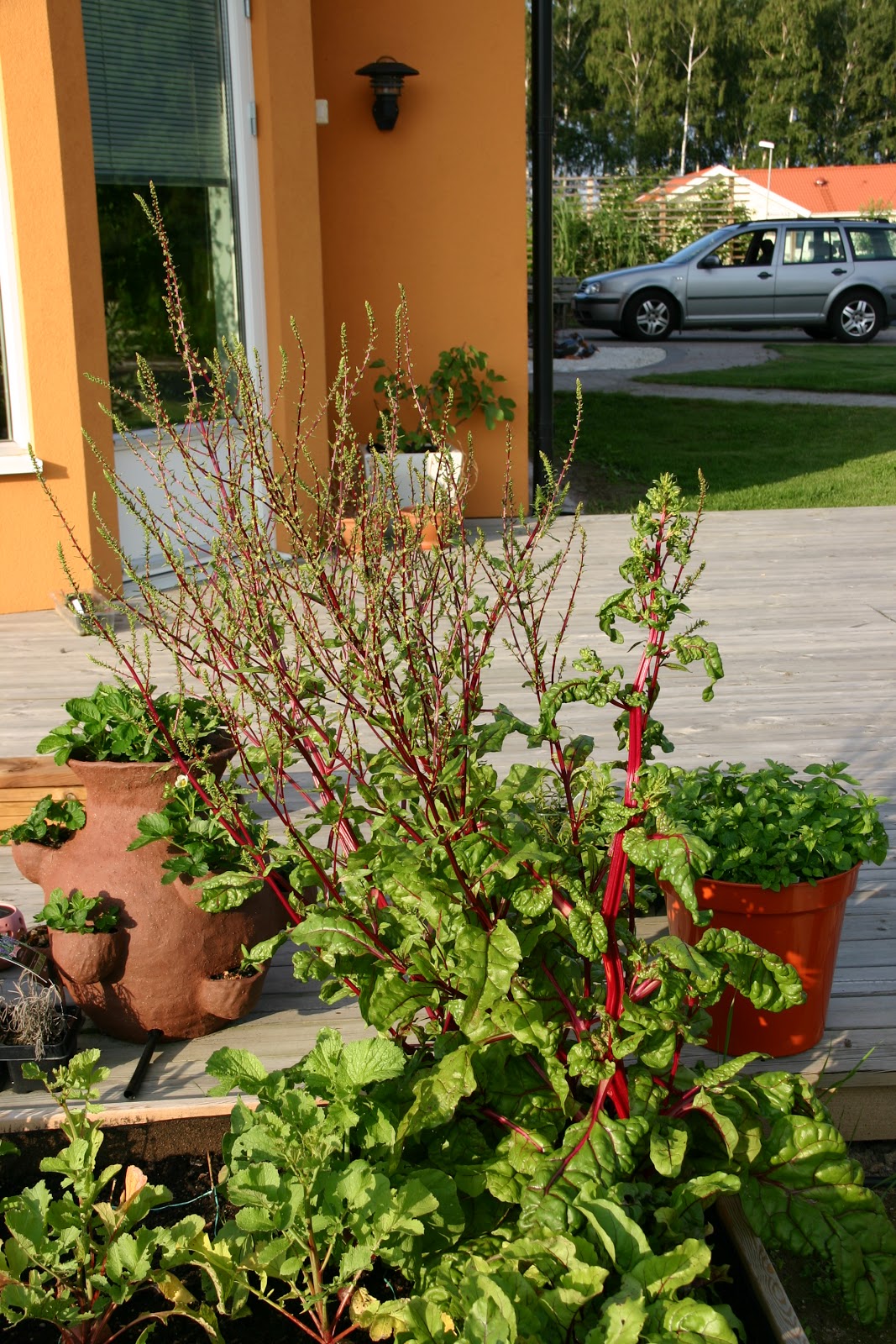
Note though: In spring we realized that one plant was coming up from the ground. Probably some reminiscent from last year. We have moved it around a lot because of the digging and this is how it looked like some days ago.
26/7-2011
So ithis plant is not really an annual: it can even survive the winter. This plant is highly decorative, far more decorative than what it looks in the picture itself.

Planted 8/6-2011 (See scheme for raised bed)
The raised bed contained for the most soil from the EcoCenter (low quality soil), but it was topped with high qualitative soil for vegetable cultivations from Hasselfors (2,5 bags).
15/6-2011: I am not 100% but there seems to be one leaf or two? Will have to double-check again.
Just realized this special kind of salad has got only 55% growability, that is kind of each other seed with come up. Not very much to play with, really... :O(

tisdag 14 juni 2011

Baby Leaf Sallad

Latin: Lactuca Sativa
Swedish: Sallat, Baby Leaf
English: Baby Leaf Salad

Producer: Bröderna Nelson, purchased at ICA Maxi 7/6-2011

Salad is supposed to be watered from below. Right now all watering is done automatically with sprinklers, which could be a problem. This salad looked colorful, so we just took it.

Planted 8/6-2011 (See scheme for raised bed)
The raised bed contained for the most soil from the EcoCenter (low quality soil), but it was topped with high qualitative soil for vegetable cultivations from Hasselfors (2,5 bags).
13/6-2011: The whole row seems to have come up already with small leaves on this day, but I did not check before that as I was on a short vacation. So they do really grow very quick it seems.

Producer's Description
This salad is a mixture of salad types: 'Amerikanischer Brauner', 'Salad Bowl', 'Little Leprechaun', 'Red Salad Bowl', 'Rouge Grenobloise' and 'Favourite'. Should be cultivated in rows near each other.
Producer's Instructions
Can be planted early, basically as soon as the ground is not frozen any longer. It is possible to cultivate it in different heats until August. The salad seeds actually need temperate climate, not over 20 degrees to grow. It enjoys loose soil rich in organic material, but it can grow basically in most soils. Needs regular watering.

Depth: 0,5cm
Distance between plants: 2-3cm
Distance between rows: 10-12cm
Full sun to half sun
Harvest: About 1,5 month after sowing, which can mean from May to October

Organic Radish 'Saxa 2'

Latin: Raphanus sativus
Swedish: Rädisa 'Saxa 2'
English: Radish 'Saxa 2'
Producer: Bröderna Nelson, purchased at ICA Maxi 7/6-2011

Radish is supposed to be a very easy vegetable to grow. It is recommended to be planted "among rows" of other vegetables as those may take a long time to grow while radish is very quick at growing. This makes the surface being exploited twice instead of only once.

Planted 8/6-2011 (See scheme for raised bed)
The raised bed contained for the most soil from the EcoCenter (low quality soil), but it was topped with high qualitative soil for vegetable cultivations from Hasselfors (2,5 bags).
I personally preferred to keep it in its own rows. Maybe little wasteful. Will have to consider another approach for next year maybe? Did not use any non woven, which actually I should as it is the recommendation of the producer.
13/6-2011: First plants already there, but I did not check before that as I was on a short vacation. So they do really grow very quick it seems.
5/7-2011: And this is the size by July.
Note: That's my hand, not a two-years-old's....

Producer's description
Easy to cultivate and can be harvested quickly after planting. Round and red radish. Can be sown among other vegetables as it will be ready for harvest before other vegetables are.
Producer's instructions
Can be sown as early as the soil is not frozen any longer up until September.
It prefers loose soil rich in organic material. To avoid attacks from insects, it is recommended to cover it with non woven.

Depth: 1cm
Distance between plants: 2-3cm
Distance between rows: 10-20cm
Full sun to half sun
Harvest: About 1,5 month after sowing, which can mean from May to October

Organic Beetroot 'Juwakugel'

Latin: Beta vulgaris L.
Swedish: Rödbeta 'Juwakugel'
English: Beetroot 'Juwakugel'
Producer: Bröderna Nelson, purchased at ICA Maxi 7/6-2011

Planted 8/6-2011 (See scheme for raised bed)
The raised bed contained for the most soil from the EcoCenter (low quality soil), but it was topped with high qualitative soil for vegetable cultivations from Hasselfors (2,5 bags).
Planted a whole row with these guys. Hope they taste good.
15/6-2011: First plant spotted.
 
Producer's description
Beetroot worth cultivating and with a good taste. With a round form and dark red color throughout. Suitable to be eaten as an early vegetable but also good pickled.
Producer's instructions
Do not sow too early as it could bloom. Sow May to Swedish Midsummer (around the 23th of June). Soak the seeds some hours before sowing to speed up their growth.
Prefers soil rich in organic material that keeps the moist.
Depth: 2cm
Distance between plants: 5cm
Distance between rows: 40cm
Full sun to half sun
Harvest: August-September

onsdag 8 juni 2011

Raised bed for vegetables - Plant scheme

First bed part on the leftmost side of the bed was planted with vegetables that do not need watering more than during dry periods.
As far, 8/6-2011, it got planted with:
- Beet root
- Spring onions
- Radish
16/6-2011, we also added:
- Romaine salad
- Rocket


The Spring onions would like to be covered with non-woven, but right now we haven't had the time to do so.

Second bed part was meant to cover salad of different kinds. Salad needs regular watering. For this reason, there will be underground watering system between row 1-2, 3-4 and 5-6 (where the "toothpicks" between rows are placed).
See how it looks like right now:

- Beets ' Rhubarb chard'
- Mixed Leaf salad
Currently not planted yet, but it will come, is the roman salad for my beloved Caesar salad and probably rocket. But as rocket is sensitive for pest attacks, we can't decide whether to give it a try or skip it completely for this year.
Third part was planted with
- Zucchini
- Cucumber
Each plant group was placed about 30cm from each corner:
Z C
C Z
No picture available currently, but the "table above" may give an hint. Let us see what happens....
Both of those with double seeds to increase the chance of getting any plant of this cultivation.

The forth part was planted with pre-sown artichokes. Only two this year as the seeds from last year mostly died. We left them outside at winter time. Not a good idea it seems for seeds....
The plant standing was a parsley plant that got on our old vegetable bed by itself from somewhere else last year. We did not have the heart to throw it away so we have moved it around a couple of times. It has started turning yellow now though...


It turned out, we could not find any other vegetable to be planted that enjoyed sandy soils. Unsure... Have we made a bad choice in choosing to have one "sandy" bed?

On the 16/6-2011, we added the following:
- Peas
- Carrots
Carrots have been chosen at all because they are supposed to be grown on sandy soil. There seems to be issues with carrot flies, but well, if that is an issue then we'll know for the next year.
Peas have been chosen as "we" wanted peas, and there was no other place to put them.
The round part of it was planted with:
- green tomatos (those had been hanging out in the kitchen for a long time. But they were never re-planted and looked rather ill. Should have tried to acclimatise them a little first but who cares. They did not look any good anyways...
- Sugar pods
- French beans
When I get my neat salix "poking devices" I ordered telephonically last Saturday, I will try to do supports for these plants. If they are still alive, of course....
See scheme for fifth part:

This part will also require watering, but no plan for how a watering system should be placed has been decided yet.

Raised bed for vegetables - Soil choice

We decided to use different kinds of soils in the different parts of the raised bed.
The reason is that different vegetables require different kinds of soil.
E.g. zucchini and cucumber need some kind of compost or manure, while salad likes soil rich in organic material and some other prefer sandy soils.
This was the result from the distribution of soil.
Personally, I would have preferred to fill everything with good quality soil or at least much more than I did, but the beds are really very large. I think it contains around 2m^2 of soil to say the least. So the low quality soil delivered by the guy had to be ok.

Zucchini 'Diamant F1'

Latin: Cucurbita pepo
Swedish: Squash/Sommarpumpa 'Diamant F1'
English: Squash, Zucchini 'Diamant F1'
Producer: Bröderna Nelson, purchased at ICA Maxi 7/6-2011

Planted 8/6-2011 (See scheme for raised bed)
The raised bed contained for the most soil from the EcoCenter (low quality soil), but it was topped with cow manure from Plantagen (2 bags).
Planted 2 plants (actually 4, but I am supposed to remove the least nice of two plants).
28/7-2011: This did not go very well, really. Out of four seeds, only one gave a try at coming up but has nearly dried out completely already. 

Producer's description
Easy to cultivate, gives good harvest that can be used as cucumber, when cooking or even for pickling.
This sort of zucchini has average green shell.
Producer's instructions
Sow on warm soil in June, or pre-cultivate 3-4 weeks before planting outdoors. 1 seed/vase, keep it warm and light when growing. Should be covered with non-woven after planting outside. Harvest the fruits when small, of a size of a cucumber.
Depth: 2cm
Distance between plants: 100cm
Distance between rows: 100cm
Full sun
Harvest: July-September

Cucumber 'Moneta'

Latin: Lucumis sativus 
Swedish: Frilandsslanggurka 'Moneta'
English: Cucumber 'Moneta'
Producer: Bröderna Nelson, purchased at ICA Maxi 7/6-2011

Planted 8/6-2011 (See scheme for raised bed)
The raised bed contained for the most soil from the EcoCenter (low quality soil), but it was topped with cow manure from Plantagen (2 bags).
Planted 2 plants (actually 4, but I am supposed to remove the least nice of two plants).
Note: 28/7-2011 Not a single plant came up so no pictures at all! Maybe  because I did not put any fabric on it? Or what could have been wrong? Will try next year again but I will precultivate. Back to this subject in one year time... :O)
Note: 19/8-2011 Nothing nothing nothing. Let us precultivate next year really!

Producer's description
Easy to cultivate. Healthy and robust species with long, somewhat lumpy green skin. Good to be eaten as is.
Producer's instructions
Sow directly on sunny and protected spot in the garden when the soil reaches 15degrees Celsius. If earlier sowing desired, pre-cultivate indoors 3-4 weeks prior to planting outdoors, when night time frost does not occur any longer.
Requires large amounts of water and heat. Do not let the cucumbers become too large. Harvest often
Depth: 2cm
Distance between plants: 15cm
Distance between rows: 125cm
Full sun
Harvest: August-September

French Beans 'Milagrow'

Latin: Phaseolus vulgaris
Swedish: Brytböna ' Milagrow'
English: French beans 'Milagrow'
Producer: Bröderna Nelson, purchased at ICA Maxi 7/6-2011

Planted 8/6-2011 (See scheme for raised bed)
The raised bed contained for the most soil from the EcoCenter (low quality soil), but it was topped with high qualitative soil for vegetable cultivations from Hasselfors (3 bags).
Planted 5 plants.

Producer's description
Easy to cultivate, gives large harvest of dark green French beans. To be eaten cooked with some suger or au gratin.  Can be frozen after quick parboil.
Producer's instructions
Sow when the earth reaches 15degrees Celsius. Soak seeds a couple of hours before planting. In the north of Sweden, it needs to be precultivated indoors in cool temperature and in light conditions. 1 seed per vase 2-3 weeks before planting outdoors. Otherwise, it can be cultivated directly outdoors on any soil.
Depth: 3cm
Distance between plants: 12cm
Distance between rows: 45cm
Full sun
Harvest: August-September

Sugar Pods

Latin: Pisum sativum L.
Swedish: Sockerärtor 'Oregon Sugar Pod'
English: Sugar pods 'Oregon Sugar Pod'
Producer: Bröderna Nelson, purchased at ICA Maxi 7/6-2011

Planted 8/6-2011 (See scheme for raised bed)
They do not grow very quickly.... Still very small after nearly two months. Loosing hope on these guys. I guess, it needed to be precultivated also?!
This is how they looked like after one month:
5/7-2011


Producer's description
Species worth cultivating. Gives pods in late Summer under a long period of time. The length of the pods will be about 10cm. Resistant against pests and other plant diseases.
Producer's instructions
Plant early, as soon as the earth is not frozen any longer until mid-june.
Plant in a row.
Appreciates soil rich in organic material, but is fine with most types of soil.
Water when dry weather.
Harvest within 2 months from planting.
Should be harvested before the pods start becoming round.
Depth: 3cm
Distance between plants: 6cm
Distance between rows: 50cm
Full sun
Harvest: July-October